Summer heat and coastal humidity change everything about epoxy installation. Here's what Nassau County facility managers need to know before scheduling.
You’ve got a facility to run, a floor that needs work, and a summer calendar that doesn’t have a lot of give. The last thing you need is a contractor who shows up, slaps down a coating in 90-degree heat, and hands you a floor that starts peeling by October.
Summer epoxy flooring installation can absolutely be done right. But it requires a different approach than a mild spring day — and most contractors in Nassau County aren’t adjusting for that. Here’s what actually happens to epoxy in summer heat, how the prep work changes, and why getting the timing right is the difference between a 15-year floor and a two-year problem.
Surface preparation is where most floors are won or lost — and summer heat makes it more demanding, not less. The general rule in professional epoxy installation is that prep work accounts for 80 to 90 percent of how a coating performs over time. When temperatures climb, that number doesn’t change. What changes is how much faster things can go wrong if the prep isn’t done correctly.
Heat accelerates everything. Concrete that’s been sitting in direct sun can reach surface temperatures well above what the air thermometer reads — sometimes 90°F or higher even when the ambient temperature feels manageable. That matters because most professional epoxy systems have a defined application range, and substrate temperature is what actually counts, not the air around it. We use an infrared thermometer on every job before mixing a single batch. It’s a small step that prevents a very expensive mistake.
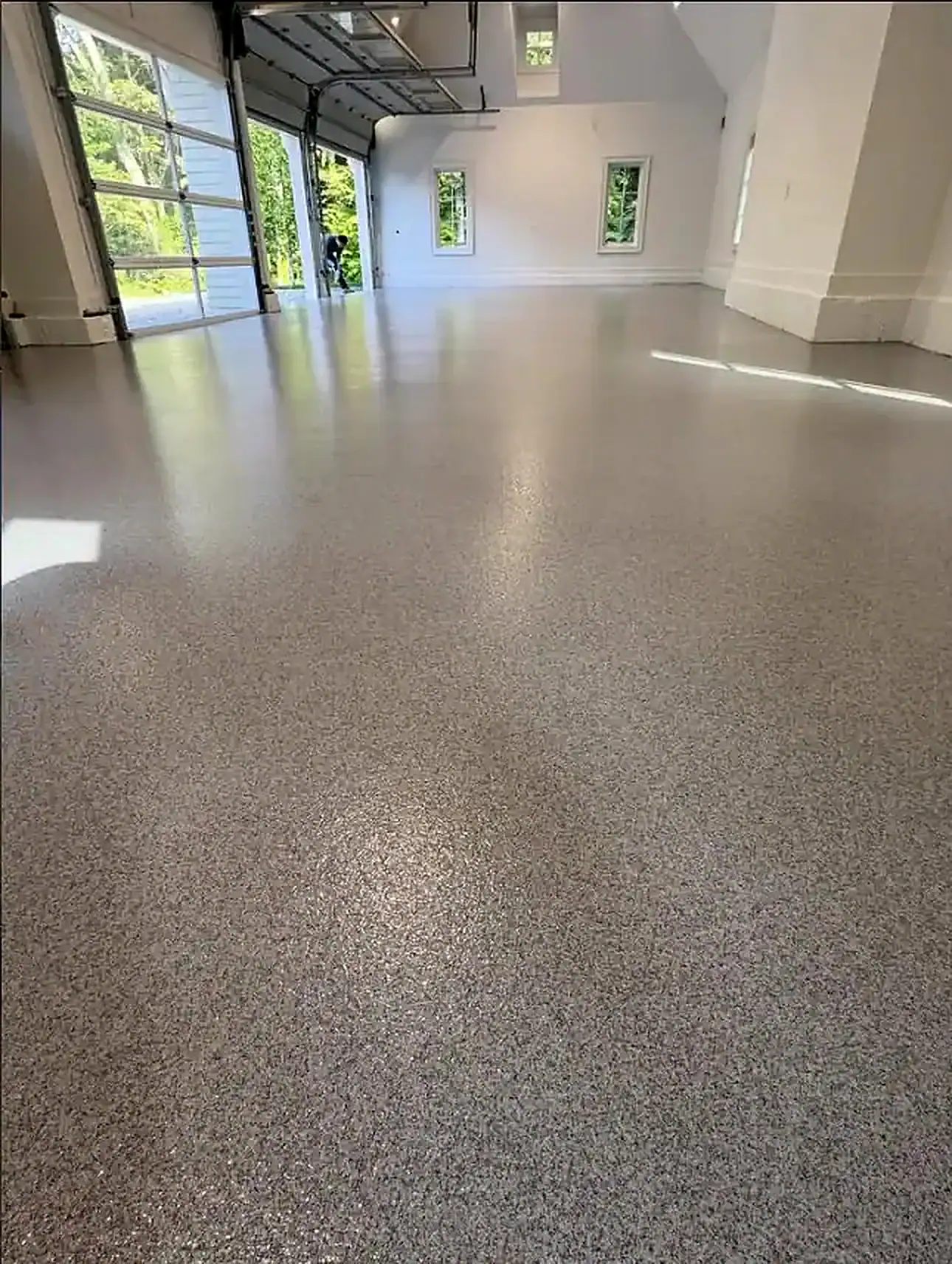
Here’s something that surprises a lot of facility managers: heat doesn’t just speed up the cure — it can actually make the floor worse if it cures too fast. Epoxy is a chemical reaction. When you mix the two components, you have a working window called pot life — the time you have to apply the product before it starts to set. At around 60°F, that window can be close to an hour. At 90°F, it can shrink to 15 minutes or less.
When a crew is working with compressed pot life and doesn’t adjust, you get uneven application. The epoxy starts setting before it’s been spread consistently, which creates soft spots, surface texture problems, and in some cases, delamination down the line. It’s not always visible right away. But it shows up.
Our professional response to this isn’t to avoid summer installations — it’s to work smarter within the conditions. Smaller batch mixing, earlier start times, and product selection that’s matched to the temperature all make a real difference. For commercial facilities in Nassau County where summer is often the only realistic window for renovations, we lean heavily on polyaspartic topcoat systems. Polyaspartics are engineered to handle elevated temperatures without the quality trade-offs of heat-accelerated standard epoxy. They cure faster by design — not because the heat is forcing them — and they’re ready for light foot traffic within 24 hours and full commercial use within 48 to 72 hours. That timeline holds even in a Long Island July.
Scheduling matters too. The best window for summer epoxy application is early morning, before the slab has absorbed a full day of sun. By midday, an unshaded concrete floor in Nassau County can be too hot to coat properly. Our experienced crews know this and plan around it. If a contractor is showing up at noon in August and not checking substrate temperature, that’s a problem worth asking about before you sign anything.
Nassau County sits between the Atlantic Ocean and Long Island Sound. That geography keeps summer humidity elevated in a way that inland markets simply don’t deal with at the same level. The county averages nearly 15 muggy days in July alone, and relative humidity regularly pushes past the threshold where standard epoxy application becomes risky.
Most professional epoxy systems require relative humidity below 60 percent during application and cure. Above 85 percent, installation should stop entirely. High humidity causes a reaction called amine blushing — a waxy film that forms on the curing surface and compromises adhesion between coats. It’s not always visible to the naked eye, but it’s there, and it weakens the bond at exactly the layer where the floor needs to hold.
The more localized problem — and one that’s especially relevant for facilities near the South Shore communities like Long Beach, Oceanside, Freeport, and Merrick, or the Sound-side towns like Glen Cove and Sea Cliff — is what’s called a sweating slab. Coastal groundwater and high water tables mean that concrete slabs in these areas can be actively emitting moisture vapor even when the surface looks and feels completely dry. A visual inspection won’t catch it. Neither will a quick tap test. The only way to know is to test using ASTM-compliant moisture methods before any coating goes down.
We run moisture testing on every single job — not as an upsell, not as an optional add-on, but as a standard step in the process. Industry data shows that over 65 percent of premature epoxy floor failures trace back to moisture that was present but not detected before installation. That’s not a statistic we’re willing to become part of. For Nassau County facilities specifically, where coastal conditions make moisture a genuine and persistent variable, skipping this step isn’t a shortcut — it’s a setup for a floor that fails.
Want live answers?
Connect with an Advanced Epoxy Flooring expert for fast, friendly support.
Downtime is the real cost most facility managers are calculating when they think about a floor project. The installation price is one number. The revenue impact of being closed longer than expected is a different number entirely — and often the bigger one.
Summer scheduling in Nassau County adds a layer of complexity because many businesses are at or near peak operational demand in July and August. Restaurants in Freeport and Merrick are packed. Automotive shops in Hempstead and Garden City are running full schedules. Healthcare facilities near the Nassau University Medical Center corridor in East Meadow don’t slow down. The window for taking a floor out of service is narrow, and it has to be planned precisely.
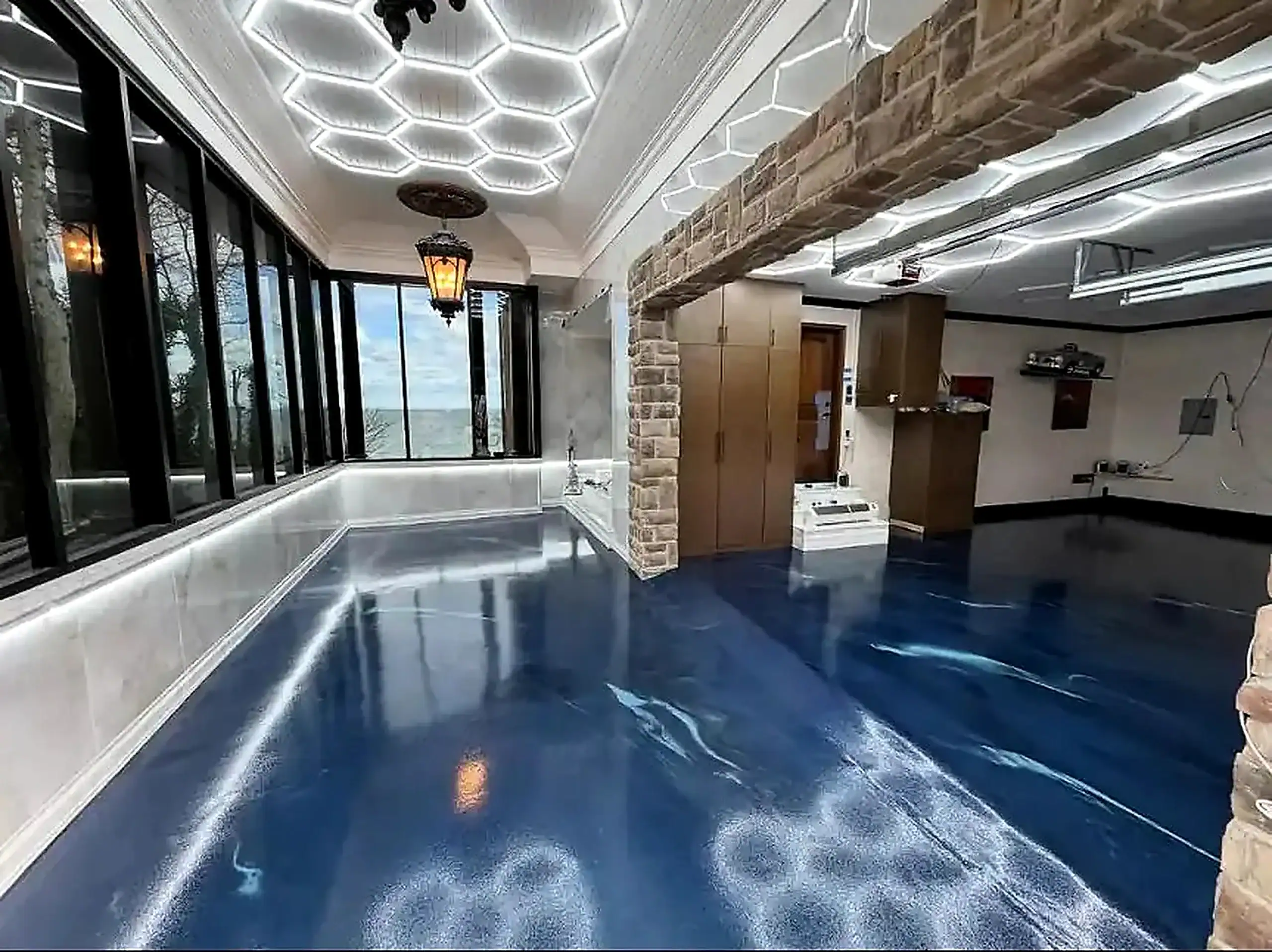
This is one of the most common questions we hear from facility managers, and the honest answer is: it depends on the system and the conditions. Standard commercial epoxy in summer conditions — properly installed, with substrate temperature in the right range and humidity under control — is typically ready for light foot traffic within 24 hours. Full commercial traffic, including forklifts and heavy equipment, usually requires 48 to 72 hours.
Polyaspartic systems move faster. Because they’re formulated to cure efficiently across a wider temperature range, they’re less vulnerable to the heat-related variables that can slow or compromise standard epoxy. For a warehouse near the I-495 corridor or a distribution facility off the Southern State Parkway that needs to be back in operation quickly, polyaspartic is often the right answer for a summer project. We’re factory-trained in polyaspartic application — it’s not a system every contractor on Long Island is equipped to install correctly.
The key to accurate downtime planning is getting a timeline estimate that’s actually tied to your specific conditions — your facility, your floor, the time of year, and the system being used. A contractor who gives you “a few days” without asking about any of those variables isn’t giving you an estimate. They’re giving you a guess. We’d rather have the full conversation upfront so you can plan your operations around a number you can actually rely on.
**Can epoxy flooring really be installed during a Nassau County summer?**
Yes — but it requires the right approach. The combination of heat and coastal humidity that Nassau County experiences from June through August creates conditions that will expose any shortcuts in the installation process. With proper scheduling, substrate temperature monitoring, humidity tracking, and product selection matched to the conditions, summer installations can produce floors that last just as long as any other time of year. We’ve been doing this on Long Island for 35 years, and summer installations are a routine part of our calendar — not something we avoid or treat as inherently higher risk.
**What happens if a contractor doesn’t account for summer heat?**
The most common outcomes are delamination, bubbling, and uneven surface texture — often appearing within the first year. These failures almost always trace back to one of three things: applying epoxy to a substrate that was too hot, working with compressed pot life without adjusting batch size or application speed, or missing a moisture issue that the heat masked. Once a floor fails this way, the entire system has to come off and the process starts over. It’s far more expensive than doing it right the first time.
**Why does Nassau County’s location specifically affect epoxy installation?**
The coastal geography matters more than most people realize. Nassau County’s position between the Atlantic and the Sound means summer air holds more moisture than inland areas, ground moisture levels are higher — particularly in South Shore and North Shore communities — and concrete slabs are more likely to be emitting vapor even when they look dry. These aren’t theoretical concerns. They’re the actual conditions we test for and manage on every job we take in this county. A contractor from outside the area, or one without deep experience on Long Island, may not be calibrated for what Nassau County’s climate actually does to a floor.
**How do we know which epoxy system is right for our facility?**
The answer depends on your traffic load, chemical exposure, facility type, and the time of year. A commercial kitchen in Baldwin has different requirements than a warehouse off the LIE or a medical office in East Meadow. We match the system to the environment — cementitious urethane for high-heat or chemical-heavy spaces, polyaspartic for fast-cure summer projects, standard commercial epoxy where conditions and timelines allow. There’s no one-size answer, and any contractor who quotes you without asking about these specifics is probably not accounting for them.
Summer is not the enemy of a good epoxy installation. Cutting corners is. The heat and humidity that Nassau County deals with from June through August are manageable variables — not reasons to wait until fall — when the contractor doing the work understands what those conditions actually require.
The right prep, the right product, the right scheduling, and honest communication about timelines are what separate a floor that holds up for 15 years from one that’s failing before the next summer arrives. If you’re managing a commercial facility in Nassau County and trying to plan a floor project around your operations, those details matter more than the square-foot price.
Advanced Epoxy Flooring has been working through Long Island summers for 35 years. If you want a straight answer about what your project actually involves and a timeline you can plan around, reach out and start that conversation.
Summary:
Article details:
Share: